Growth of FDI in LMICs
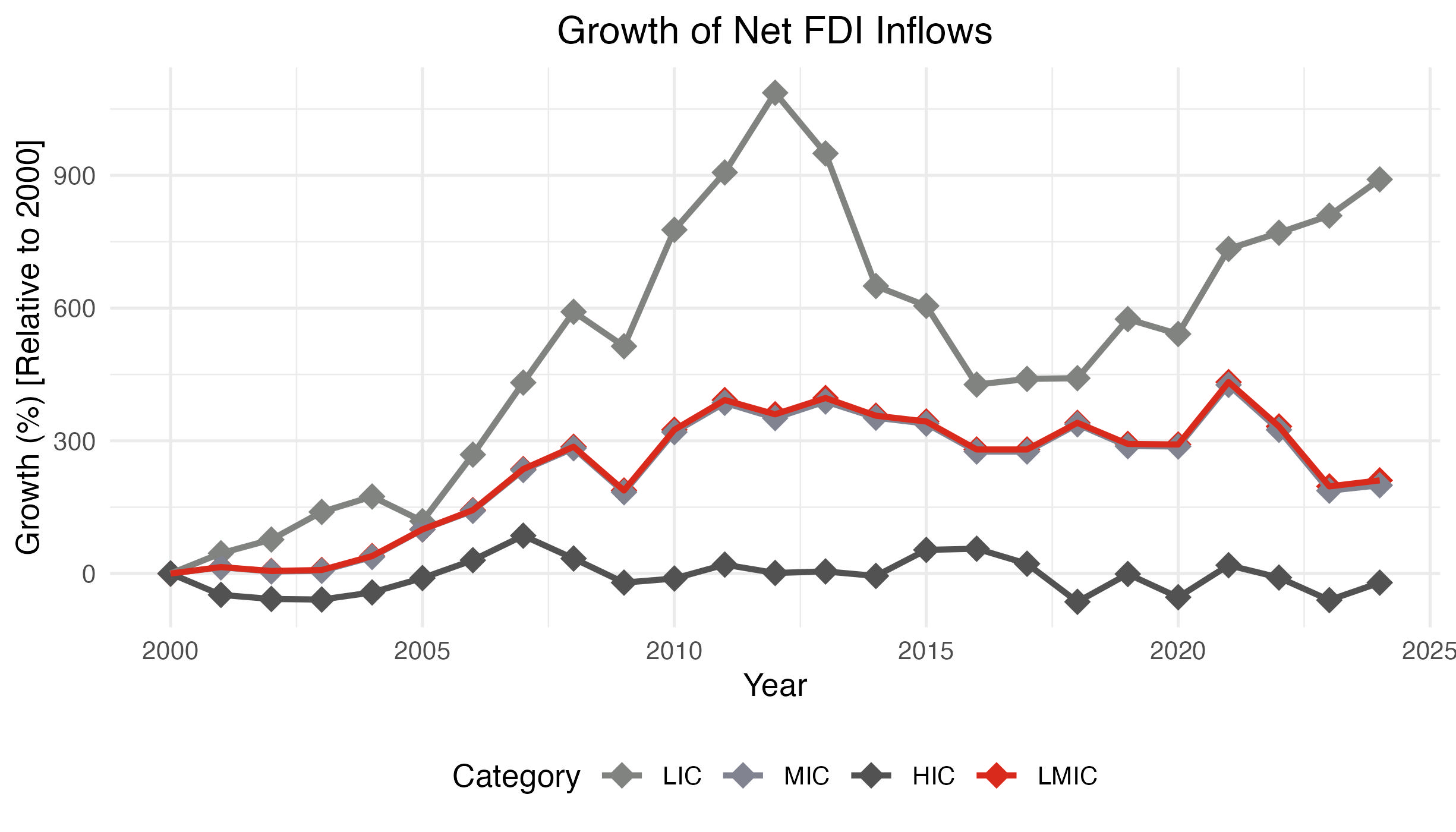
Lower- and Middle-Income Countries (LMICs) have seen an increasing rate of fdi inflow in recent decades
Source: World Bank
Tertiary Enrollment Growth in LMICs
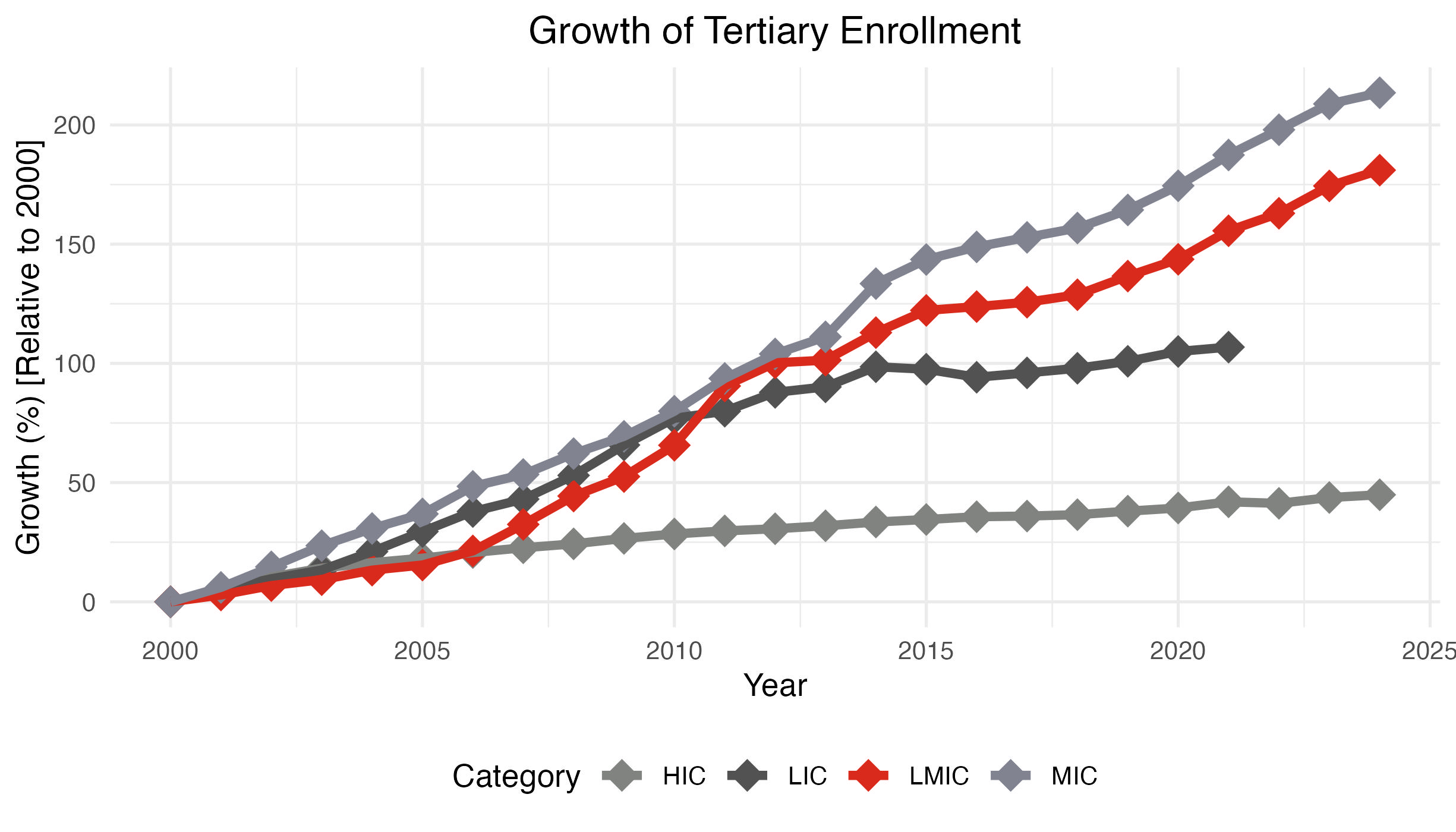
Tertiary enrollment rates have increased in LMICs
Source: World Bank
Growth since 2000 not levels (graph error)
Tertiary education is useless by itself, it requires a labor market to complement it
Research Question
Hypothesis: Multinational Firms affect skill specialization decisions
- I use administrative data of university applications and location of MNCs within industrial parks in Costa Rica from 2010 to 2019
Identification Strategy
- Spatial and temporal variation in industry composition
- Distance between students and MNCs
- Key Variable: Exposure to near MNCs
Students are aware of all multinational firms in the country, but they receive stronger “signals” from nearby oness
Preview of Results
- A shift from low to high exposure to Manufacturing MNCs increases the probability of choosing a major within Stem and Applied Sciences by 52.9 p.p.
- Decreases probability of choosing Arts by 25 p.p. and Social Sciences by 27.9 p.p.
- A shift from low to high exposure to Administrative Service MNCs increases the probability of choosing a major within Social Sciences and Professional Studies by 39.81 p.p.
- Decreases the probability of choosing Arts by 30.58 p.p. and STEM and Applied Sciences by 8.96 p.p.
- Directional effects are robust to removing the industry-field mapping
- Multinational Firm effects are extremely local
- Heterogeneity tests show no difference between men and women
distance decay: Strong within 5km but decays rapidly. Students respond to hyper-local labor-market signals.
Preview of Results
- A shift from low to high exposure to Manufacturing MNCs increases the probability of choosing a major within Stem and Applied Sciences by 52.9 p.p.
- Decreases probability of choosing Arts by 25 p.p. and Social Sciences by 27.9 p.p.
- A shift from low to high exposure to Administrative Service MNCs increases the probability of choosing a major within Social Sciences and Professional Studies by 39.81 p.p.
- Decreases the probability of choosing Arts by 30.58 p.p. and STEM and Applied Sciences by 8.96 p.p.
- Directional effects are robust to removing the industry-field mapping
- Multinational Firm effects are extremely local
- Heterogeneity tests show no difference between men and women
distance decay: Strong within 5km but decays rapidly. Students respond to hyper-local labor-market signals.
Preview of Results
- A shift from low to high exposure to Manufacturing MNCs increases the probability of choosing a major within Stem and Applied Sciences by 52.9 p.p.
- Decreases probability of choosing Arts by 25 p.p. and Social Sciences by 27.9 p.p.
- A shift from low to high exposure to Administrative Service MNCs increases the probability of choosing a major within Social Sciences and Professional Studies by 39.81 p.p.
- Decreases the probability of choosing Arts by 30.58 p.p. and STEM and Applied Sciences by 8.96 p.p.
- Directional effects are robust to removing the industry-field mapping
- Multinational Firm effects are extremely local
- Heterogeneity tests show no difference between men and women
distance decay: Strong within 5km but decays rapidly. Students respond to hyper-local labor-market signals.